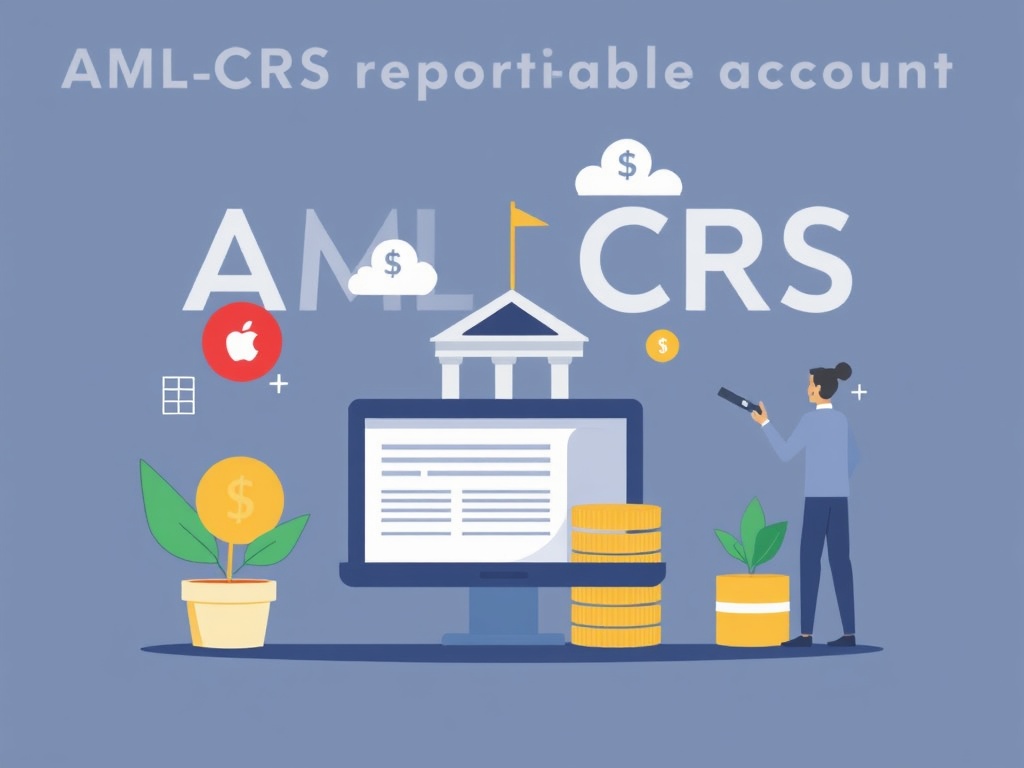
In the evolving landscape of global financial compliance, AML CRS reportable accounts have become a critical focus for financial institutions, tax authorities, and multinational corporations. The Automatic Exchange of Information (AEOI) framework, particularly the Common Reporting Standard (CRS), mandates that financial institutions identify and report AML CRS reportable accounts to their respective tax authorities. This ensures transparency, combats tax evasion, and strengthens international cooperation in financial crime prevention.
This guide delves into the intricacies of AML CRS reportable accounts, covering their definition, regulatory framework, identification processes, reporting obligations, and best practices for compliance. Whether you are a compliance officer, tax professional, or financial institution representative, this article will equip you with the knowledge to navigate the complexities of AML CRS reportable accounts effectively.
What Are AML CRS Reportable Accounts?
Definition and Purpose
An AML CRS reportable account refers to a financial account held by an individual or entity that is subject to reporting under the Common Reporting Standard (CRS) and Anti-Money Laundering (AML) regulations. These accounts are identified based on specific criteria outlined in the CRS, which aims to enhance tax transparency by automatically exchanging financial account information between participating jurisdictions.
The primary purpose of identifying and reporting AML CRS reportable accounts is to prevent tax evasion and financial crimes. By mandating financial institutions to collect and report detailed information about account holders, tax authorities can cross-reference data to detect discrepancies, unreported income, or illicit financial activities. This global initiative is part of a broader effort to create a more transparent and accountable financial system.
Key Components of AML CRS Reportable Accounts
To qualify as an AML CRS reportable account, an account must meet certain conditions set forth by the CRS. These include:
- Account Holder Identification: The account must be held by a tax resident in a CRS-participating jurisdiction. This includes individuals, entities, and certain types of trusts or foundations.
- Financial Account Types: The account must fall under the definition of a "financial account," which includes bank accounts, brokerage accounts, custodial accounts, and certain insurance or annuity contracts.
- Reportable Information: Financial institutions must gather and report specific details about the account holder, such as name, address, tax identification number (TIN), account balance, and income earned.
- Due Diligence Procedures: Institutions must conduct enhanced due diligence to verify the tax residency of account holders and identify any potential risks associated with the account.
Understanding these components is essential for financial institutions to accurately identify and report AML CRS reportable accounts while ensuring compliance with global regulations.
The Regulatory Framework Behind AML CRS Reportable Accounts
Global Initiatives: CRS and AEOI
The Common Reporting Standard (CRS) was developed by the Organisation for Economic Co-operation and Development (OECD) as part of the Global Forum on Transparency and Exchange of Information for Tax Purposes. The CRS builds upon the earlier FATCA (Foreign Account Tax Compliance Act) but expands its scope to include a broader range of financial institutions and account holders across participating jurisdictions.
The Automatic Exchange of Information (AEOI) framework, under which AML CRS reportable accounts are reported, requires financial institutions to automatically transmit account information to their local tax authorities, who then exchange this data with the tax authorities of the account holder’s country of tax residency. As of 2024, over 100 jurisdictions have committed to implementing the CRS, making it a cornerstone of international tax transparency.
Role of Financial Institutions in Compliance
Financial institutions play a pivotal role in the CRS framework by acting as intermediaries between account holders and tax authorities. Their responsibilities include:
- Identifying Reportable Accounts: Institutions must implement robust systems to identify accounts held by tax residents of CRS-participating jurisdictions.
- Conducting Due Diligence: Enhanced due diligence procedures, such as collecting self-certifications and verifying tax residency, are required to accurately determine reportability.
- Reporting to Tax Authorities: Financial institutions must compile and submit detailed reports on AML CRS reportable accounts to their local tax authorities by specified deadlines.
- Record Keeping: Institutions must maintain records of due diligence procedures and account information for a minimum of six years to ensure audit readiness.
Failure to comply with these obligations can result in severe penalties, reputational damage, and legal consequences. Therefore, financial institutions must prioritize compliance with CRS and AML regulations to mitigate risks and uphold their obligations.
Jurisdictional Variations and Local Regulations
While the CRS provides a standardized framework, individual jurisdictions may impose additional requirements or variations in implementation. For example:
- Dual Reporting Jurisdictions: Some countries may require financial institutions to report AML CRS reportable accounts to both local and foreign tax authorities, depending on the account holder’s residency.
- Local Due Diligence Rules: Jurisdictions like the European Union (EU) may have stricter due diligence requirements under the Fifth and Sixth Anti-Money Laundering Directives (5AMLD and 6AMLD).
- Penalty Structures: The severity of penalties for non-compliance varies by jurisdiction, with some countries imposing hefty fines or criminal charges for violations.
Financial institutions operating in multiple jurisdictions must stay informed about local regulations to ensure full compliance with all applicable laws.
Identifying AML CRS Reportable Accounts: A Step-by-Step Process
Step 1: Defining the Scope of Financial Accounts
The first step in identifying an AML CRS reportable account is to determine whether the account falls within the scope of the CRS. The CRS defines a "financial account" broadly to include:
- Depository accounts (e.g., savings, checking, or time deposit accounts).
- Custodial accounts (e.g., brokerage accounts or investment accounts).
- Debt or equity interests in investment entities (e.g., hedge funds, private equity funds).
- Cash value insurance contracts and annuity contracts.
- Certain types of retirement accounts.
Financial institutions must review their account types and categorize them based on the CRS definitions to determine which accounts are potentially reportable.
Step 2: Determining Tax Residency of Account Holders
The core criterion for an AML CRS reportable account is the tax residency of the account holder. The CRS requires financial institutions to identify whether an account holder is a tax resident in a CRS-participating jurisdiction. This is typically determined through:
- Self-Certification: Account holders must provide a self-certification form declaring their tax residency. This form includes details such as their name, address, and tax identification number (TIN).
- Documentary Evidence: Institutions may request supporting documents, such as tax residency certificates or utility bills, to verify the information provided.
- Electronic Verification: Some jurisdictions allow or require electronic verification of tax residency through government databases or third-party services.
In cases where an account holder refuses to provide a self-certification or the information is inconsistent, the institution must apply enhanced due diligence procedures to resolve the discrepancy.
Step 3: Conducting Enhanced Due Diligence (EDD)
Enhanced due diligence is crucial for accurately identifying AML CRS reportable accounts, particularly for high-risk account holders. The CRS outlines specific EDD procedures, including:
- Risk Assessment: Institutions must assess the risk profile of each account holder based on factors such as their country of tax residency, source of funds, and transaction patterns.
- Additional Documentation: For high-risk jurisdictions or complex account structures, institutions may require additional documentation, such as beneficial ownership information or source of wealth declarations.
- Ongoing Monitoring: Financial institutions must continuously monitor accounts for changes in tax residency or other risk factors that may affect reportability.
Failure to conduct adequate due diligence can result in misreporting or non-reporting of AML CRS reportable accounts, exposing institutions to regulatory penalties and reputational risks.
Step 4: Handling Preexisting and New Accounts
The CRS distinguishes between preexisting accounts (opened before the institution’s implementation of CRS) and new accounts (opened after implementation). The due diligence procedures for each are as follows:
- Preexisting Accounts:
- For individual accounts with a balance or value exceeding $1 million, institutions must review available electronic records and conduct a paper record search to identify tax residency.
- For entity accounts, institutions must determine whether the entity is a passive non-financial entity (NFE) and identify its controlling persons who are tax residents in CRS-participating jurisdictions.
- New Accounts:
- Institutions must obtain a self-certification from the account holder at the time of account opening to determine tax residency.
- For entity accounts, the institution must obtain a self-certification from the entity and, if applicable, from its controlling persons.
Properly categorizing and processing accounts based on their status (preexisting or new) is essential to ensure compliance with CRS reporting requirements.
Reporting Obligations for AML CRS Reportable Accounts
What Information Must Be Reported?
Financial institutions are required to report detailed information about AML CRS reportable accounts to their local tax authorities. The information to be reported includes:
- Account Holder Information: Name, address, tax identification number (TIN), and date of birth (for individuals).
- Account Information: Account number, account balance or value as of the end of the calendar year, and gross amount of interest, dividends, and other income paid or credited to the account.
- Financial Institution Information: Name, address, and Global Intermediary Identification Number (GIIN) or equivalent.
- Controlling Persons (for Entities): For entity accounts, the names, addresses, TINs, and dates of birth of the controlling persons who are tax residents in CRS-participating jurisdictions.
This information is then exchanged automatically between tax authorities under the AEOI framework, enabling cross-border tax transparency.
Reporting Deadlines and Procedures
The CRS sets specific deadlines for financial institutions to report AML CRS reportable accounts. These deadlines vary by jurisdiction but generally follow the following timeline:
- Due Diligence Completion: Institutions must complete due diligence procedures and identify reportable accounts by December 31 of each year.
- Report Submission: Reports on AML CRS reportable accounts must be submitted to local tax authorities by a specified deadline, often between May and September of the following year.
- Data Exchange: Tax authorities exchange the reported information with the tax authorities of the account holders’ countries of tax residency within 6–9 months of submission.
Financial institutions must adhere to these deadlines to avoid penalties and ensure the timely exchange of information.
Penalties for Non-Compliance
Non-compliance with CRS reporting obligations can result in severe penalties for financial institutions. These penalties vary by jurisdiction but may include:
- Monetary Fines: Institutions may face fines ranging from thousands to millions of dollars, depending on the severity of the violation.
- Reputational Damage: Failure to comply with CRS can erode customer trust and damage an institution’s reputation in the global financial market.
- Legal Consequences: In extreme cases, non-compliance may lead to criminal charges, license revocation, or other legal actions against the institution or its officers.
- Enhanced Scrutiny: Regulatory authorities may subject non-compliant institutions to increased monitoring, audits, or additional reporting requirements.
To mitigate these risks, financial institutions must prioritize compliance with CRS and AML regulations, implementing robust systems and processes to accurately identify and report AML CRS reportable accounts.
Best Practices for Managing AML CRS Reportable Accounts
Implementing Robust Compliance Systems
To ensure accurate identification and reporting of AML CRS reportable accounts, financial institutions should invest in advanced compliance systems and technologies. Key components of an effective compliance system include:
- Automated Due Diligence Tools: Use software solutions that automate the collection and verification of self-certifications, tax residency information, and due diligence documentation.
- Risk Assessment Algorithms: Implement algorithms to assess the risk profile of account holders based on factors such as jurisdiction, transaction patterns, and account activity.
- Audit Trails: Maintain detailed audit trails of all due diligence procedures, account reviews, and reporting activities to demonstrate compliance during regulatory inspections.
- Employee Training: Provide regular training to staff on CRS requirements, due diligence procedures, and the importance of identifying AML CRS reportable accounts.
By leveraging technology and fostering a culture of compliance, institutions can streamline their processes and reduce the risk of errors or omissions.
Collaborating with Tax Authorities and Industry Peers
Collaboration with tax authorities and industry peers is essential for staying informed about evolving CRS requirements and best practices. Financial institutions can:
- Participate in Industry Forums: Join industry associations, such as the OECD’s Global Forum or local banking associations, to stay updated on regulatory changes and share insights with peers.
- Engage with Tax Authorities: Proactively communicate with local tax authorities to clarify reporting requirements, seek guidance on complex cases, and address any compliance concerns.
- Leverage Regulatory Guidance: Regularly review guidance documents issued by the OECD, local regulators, and industry bodies to ensure alignment with the latest CRS standards.
Collaboration not only enhances compliance but also fosters a collective effort to combat tax evasion and financial crimes.
Addressing Common Challenges
Financial institutions often face challenges in identifying and reporting AML CRS reportable accounts. Some common challenges and their solutions include:
- Complex Account Structures: Entities with complex ownership structures, such as trusts or multi-tiered partnerships, may pose difficulties in identifying controlling persons. Institutions should implement thorough beneficial ownership verification processes to address this.
- Inconsistent Self-Certifications: Account holders may provide incomplete or inaccurate self-certifications. Institutions should follow up with additional due diligence to resolve discrepancies and ensure accurate reporting.
- Jurisdictional Variations: Differences in local regulations and CRS implementation can create confusion. Institutions should maintain a jurisdiction-specific compliance matrix to navigate these variations effectively.
- Data Privacy Concerns: Balancing compliance with data privacy laws, such as GDPR, can be challenging. Institutions should implement robust data protection measures and ensure that reported information is handled securely.
By proactively addressing these challenges, financial institutions can enhance their compliance efforts and minimize risks associated with AML CRS reportable accounts.
The Future of AML CRS Reportable Accounts: Trends and Predictions
Expansion of CRS Participation
The CRS framework continues to evolve, with an increasing number of jurisdictions committing to its implementation. As of 2024, over 100 countries have signed on to the CRS, and this number is expected to grow. Key trends in CRS participation include:
- New Adopters: Jurisdictions in Africa, Asia, and Latin America are progressively joining the CRS, expanding the global reach of automatic information exchange.
- Enhanced Transparency: Future iterations of the CRS may introduce stricter reporting requirements, such as the inclusion of crypto-asset accounts or additional details on beneficial ownership.
- Integration with Other Frameworks: The CRS is increasingly being integrated with other global compliance frameworks, such as the Financial Action Task Force (FATF) recommendations and the OECD’s BEPS (Base Erosion and Profit Shifting) project.
Financial institutions must stay agile and adapt to these changes to maintain compliance with evolving CRS standards.
Technological Advancements in Compliance

Understanding AML CRS Reportable Accounts in the Era of Blockchain Transparency
As the Blockchain Research Director at a leading fintech research firm, I’ve observed firsthand how the intersection of anti-money laundering (AML) regulations and the Common Reporting Standard (CRS) is reshaping compliance in decentralized finance. The concept of an AML CRS reportable account is no longer just a regulatory checkbox—it’s a critical framework for ensuring financial integrity in an ecosystem where pseudonymity and global reach are inherent. From my perspective, the challenge lies not in the existence of these reporting requirements but in their practical enforcement across blockchain networks, where traditional KYC (Know Your Customer) mechanisms often fall short. Smart contracts, while revolutionary for automation, do not inherently possess the identity verification capabilities required by CRS. This gap necessitates innovative solutions, such as zero-knowledge proofs or decentralized identity protocols, to bridge the compliance divide without sacrificing the efficiency that blockchain promises.
In my work, I’ve seen how financial institutions and crypto-native projects are grappling with the nuances of identifying reportable accounts under CRS, particularly when dealing with cross-border transactions or privacy-preserving assets like Monero or Zcash. The key insight here is that compliance must evolve beyond surface-level transaction monitoring. For instance, a wallet interacting with multiple jurisdictions may trigger reporting obligations even if its owner’s identity isn’t directly exposed on-chain. This underscores the need for dynamic, real-time risk assessment tools that leverage on-chain analytics and off-chain data sources. My team’s research has shown that institutions adopting hybrid compliance models—combining blockchain forensics with traditional AML frameworks—achieve a 30% higher detection rate of suspicious activities. The future of AML CRS reporting in blockchain isn’t about restricting innovation; it’s about embedding compliance into the architecture of decentralized systems from the ground up.